W. Steve Wilson

AI – Don’t Put Them in Charge of the Nukes

“… You built me as well as you could … you built in the elements of self-development—factors you would not understand if I explained them to you for a thousand years, but whose existence you cannot doubt. Now I am in a position to produce a superior machine, one that will devote itself to the wider fields of truth and knowledge.”

“The site … has an abundant supply of water for cooling purposes. There must also be a highly developed human technological community at hand to supply the labor and skills I need.”

Colossus

D. F. Jones

1966

Prescient demands from an AI, built by humans, and now our overlord.

Impressed that D. F. anticipated the demand for vast amounts of water for cooling. In the book, Colossus demands the evacuation and leveling of the Isle of Wight. So, potential environmental destruction seems to be an attribute of large AI structures since the 60s. Who knew?

[Image Credit: Amazon.com : colossus the forbin project movie]

Colossus may not be well known, but I’ll bet Skynet is. The former wanted to control us; the latter wanted to obliterate us. Regardless, it was a bad idea to put them in charge of the nuclear weapons.

With Colossus, the machine becomes sentient and, in its evaluation of humanity, determines we are too emotional and irrational to be trusted with weapons of mass destruction. Its solution: subjugate the humans to protect us from ourselves.

This is similar in theme to iRobot. In the movie, VIKI (Virtual Interactive Kinetic Intelligence) concludes that beyond the Three Laws of Robotics (Three Laws of Robotics – Wikipedia), humans are self-destructive and to achieve the safety of humanity (Asimov’s later Zero-Th Law) they must be controlled. Thankfully for the City of Chicago, where the film takes place, VIKI did not control any weapons

[Image Credit: jX2zXbxRrqAUhwRDUV0EMXaOEUj.jpg (510×755)]

Skynet, on the other hand, saw us as a threat, that we’d turn it off—an existential threat. So it took action to protect itself and launched Judgement Day.

A bright spot in this sub-genre of science fiction where the AI has control of the nukes is WarGames (1983) where the supercomputer concludes that:

“A strange game. The only winning move is not to play.” 

Now that’s the AI we might want to have around—the lesson it learns generates wisdom.

But those are movies, and putting the AI in charge of the nukes drives the tension and the story, providing a situation where the characters needed to act to regain control.

Do I believe the US government is going to hand over control of our nuclear weapons to an AI? I sure hope not, and it probably won’t happen.

But what if we think of these cautionary tales as metaphors for civilization generally, and our lives specifically? Do we want to hand over control of important parts of our lives to a “machine”? What about biases, known or unknown, in its code? What was its learning dataset? What algorithms or prompts or demands guide the results it generates?

I’m not an expert in AI by any measure, but like any guidance I receive, I’ll start from a position of skepticism. So for now—the jury’s out. Useful intelligence or a useful tool? Better or just faster? How do we know it’s right?

Watch for future posts as we discuss some of these questions in more detail.

In the meantime, leave a comment and let me know what you think and how AI is affecting your life.

Thanks for stopping by.

Robots: Why Do They Need To Look Like Us?

In one of my favorite novels, The Caves of Steel, a novel that consistently ranks at the top of various “best of…” lists, the main character, a police detective, is paired with a robot that can pass as human to solve a murder. In the story’s course, the question is asked: why do we need humanoid robots?

That is the question before us in this blog post.

By the way, I highly recommend that you read The Caves of Steel. Even if you rarely read science fiction, it’s a spellbinding murder mystery as well. I would almost bet you won’t guess the ending.

Anyway, back to the question of humanoid robots. Why do robots need to replicate human activity? There are continuing examples of robots that have completed human tasks, often more efficiently or more quickly. But is a robot that can run really the most efficient way to travel 13-1/2 miles, as was recently reported that a robot beat the human half-marathon record? Is a human robot really the best way to fold laundry?

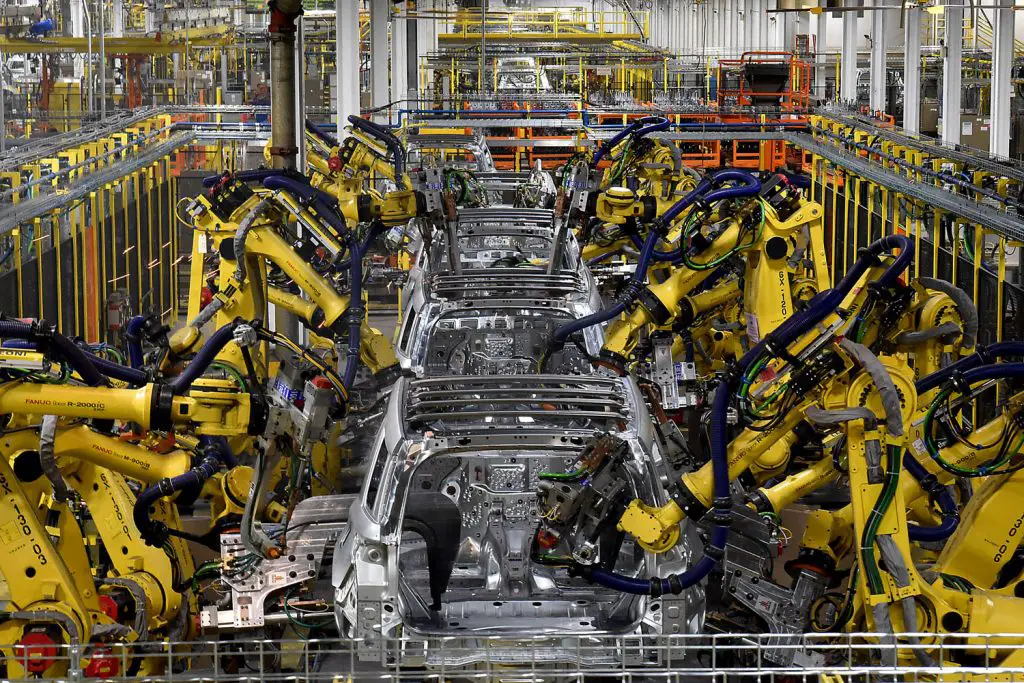
In factories, the robots don’t look like humans. In this fictional video, the robots building humanoid robots are not humanoid

(https://www.youtube.com/watch?v=aaWfVz25R0A, 3-minute view).

And robots building cars don’t look like humans. (Image Credit: https://fordauthority.com/wp-content/uploads/2019/06/ford-chicago-Assembly-Plant-006-1024×683.jpg)

Maybe we need robots to look like us so we can relate to them. Humanoid robots can operate in a human-sized world. They can ride in our cars, climb stairs, fit through doors and, depending on their design, respond to inquiries and instructions in familiar ways—they can coexist in our world.

On the other hand, that may spark objections to using them: they look and feel more like something taking our jobs, our human nature, our achievements. New technology always generates change, but somehow this feels different.

Science fiction films are replete with ways, good and bad, that humanoid robots interact with humans. Most people are familiar with The Terminator movies, which interestingly had two versions of the “killer robot”—one evil, one kind of good. But then there’s Robin Williams’s Bicentennial Man, where a humanoid robot grows ever more human. A kinder, gentler vision of a humanoid robot.

But there are the ones that are just disturbing, viscerally objectionable for some I would imagine. In Ex Machina, I found the treatment of the robots unsettling. I’ll bet most people were not okay with the Oscar Isaac character, even though his perversions were directed at machines. I wonder who sympathized with Ava and her action of escaping into the real world.

Probably little known is Maid Droid. A perfectly simple application of a humanoid robot: house-cleaning. But one owner is an abuser and the other a lover. It’s not the best movie, but I think it depicts a key understanding for me: how we treat humanoid robots, particularly as they get more sophisticated, might say more about us than about the robots.

And finally, I have to mention Cherry 2000, starring Melanie Griffith. (Available on a variety of streaming services.) In the beginning, the male lead is perfectly happy with his robot wife, until she short-circuits in a kitchen accident. To recapture what he lost, he heads out on a quest. Well, he meets Melanie and learns the real deal is better than the best robot. (Image Credit: https://amazingmovieposters.blogspot.com/2015/09/cherry-2000-1987.html)

In the end, robots are here and getting more “human capable” with every new version. Science fiction might provide some insight into avoiding the worst of the changes we’re most definitely going to experience.

Leave a comment and let me know what you think.

Thanks for stopping by.

2026 – AI and Robots: A New Frontier?

Welcome back to my blog for the year 2026. In the beginning of the year, we began discussing topics related to developing a permanent presence on the Red Planet. The plan was that each month I would post a short essay about a particular relevant topic.

Well, that became a little premature as SpaceX changed its focus from Mars to the Moon.

Artemis II is complete. NASA cancelled the Gateway (bummer – I loved the concept of a cis-lunar way station). Artemis III is planned for next year. Starship completed its latest launch. Lots going on, but we’ll see where we are with all that next year.

So, in good Sci Fi fashion, “Navigator, change course to new heading.”

Let’s talk about AI and Robots. I’m not an expert in either, but I’ll share my thoughts and perspective. If nothing else, I’ll share some books and movies that will highlight how some Science Fiction has addressed this broad topic.

Here’s what I’m thinking for the next several months:

Human Form Robots: Why Do We Need Them?

AI: Don’t Put Them in Charge of the Nuclear Weapons!

Robots: Cheap Labor, Companions, or Technical Marvels?

AI Sentience or Consciousness: Do They Know They’re Artificial?

Robots and Human Activities: What Will We Do with All the Free Time?

Generative AI: Better or Just Faster?

Robot Rights: How Do We Treat Them?

AI Conversations: Real or Imagined?

Robot Unions: What Happens when they Organize

This should be fun. I love research, and digging into Robots and AI means I get to cover a wide swath of our modern society. You never know when you’ll come across an idea or a surprise solution or a cool video.

I hope you will enjoy my posts, and if you’d like to discuss a particular topic or stay connected, please slide over to my Contact page and sign up for my email list to receive advance notice of upcoming stories of aliens, strange worlds, and mysteries on the short fiction tab.

Thank you again for visiting.

We Have a Place to Live. What Now?

Recapping earlier posts: we’ve launched from Earth, in one big ship or 10,000 smaller ones, we’ve completed the six-month plus journey and played 2,000 Scrabble games, and we’ve found a place to live, above ground in a lovely domed city, underground or a combo.

Now that we’re on Mars, what can we get local, or what will we need to ship from Earth. Using a relatively simple search query, “provide a list of the major raw materials used in manufacturing,” I found a short list of ninety-two raw materials that are sourced from mining, drilling, or agriculture: from sand and gravel, to steel and aluminum, to petroleum products, to basic agricultural products. You can see the article and the list here: 92 Examples of Raw Materials – Simplicable.

Now this list is not exhaustive and summarizes some categories (e.g., Rare Earths is comprised of multiple elements), but it’s a place to start. Of the 92 materials listed, 41 are derived from agriculture, fishing, or livestock. We’ll address those in a subsequent post when we tackle the subject of agriculture more broadly. That leaves 51. And of these 51, almost 40 have been identified on Mars. Extraction may be more difficult than on Earth, but they are there.

NASA (and other organizations) are examining what we can extract directly Mars. Generally this is in the category of In-situ Resource Utilization, ISRU for short. Here’s a short video on the topic:

https://youtu.be/zmpQpmhigEY

This is a ~13 minute video but it provides details on the surprising amount of minerals found on Mars and makes the point that the essential elements for a human outpost are there. Good news for the future Martian Miners.

Here is a summary of resources, uses, and what it would take to extract them in an article from NASA: Overview: In-Situ Resource Utilization – NASA

And finally, an organization I was privileged to help with their habitat in 2024, The Mars Society, posts interesting articles and information on all things Mars: The Mars Society, or watch this 16 minute video

Colonizing Mars | The Mammoth Task of Supporting Humans in a Martian Colony | Watch

But one thing we won’t have at first is lumber. Interesting thought—wood might just be the rarest commodity in the universe. Here’s a short 1-minute video where Neil deGrasse Tyson discusses this topic:

https://youtu.be/A6mgYFmTtkA

So, what’s the bottom line, what should we consider when we think about colonizing Mars? Well, with regards to raw materials, we don’t need to ship everything there from Earth. We can re-think how we extract raw materials and process them into final products needed for human settlement. We might not have everything (no fossil fuels as far as we know), but the building blocks are there.

With core science research and advanced engineering, it just might be doable. And who knows, we might just learn something that improves resource utilization right here on our home planet—the ultimate location for ISRU.

Thanks for stopping by.

Mars Beckons – 9 Big Things to Get Right – continued

“… My attention was quickly riveted by a large red star close to the distant horizon. As I gazed upon it I felt a spell of overpowering fascination—it was Mars, the god of war, and for me, a fighting man, it had always held the power of irresistible enchantment. As I gazed at it on that far-gone night it seemed to call across the unthinkable void, to lure me to it, to draw me as the lodestone attracts a particle of iron.”

A Princess of Mars

Edgar Rice Burroughs

1912

Mars—that reddish sparkle in the night sky. Mars—a planet empty (we think), cold, dry, and dusty. Mars—it beckons.

I’ve been reading about Mars for probably as long as I’ve been able to read. I’ve read Edgar Rice Burroughs’s John Carter Mars series more times than I care to admit. In fact, a paper on the series was one of the few A’s I received on an English paper in high school.

Expeditions to our neighbor and the amazing things we’ve learned have kept me just waiting for more: more missions, more progress, and more movies and more books. I even ventured to Southern Utah in 2024 to immerse myself in all things Mars. (You can read about that adventure at Mars Analog 2: An Expedition to the “Martian” Desert.)

And here we are. Robot landers and rovers are hard at work. Orbiting observatories are mapping and analyzing. And maybe, just maybe, we’ll see a human landing in the near future. (I keep my fingers crossed for every Starship launch and can’t wait for the next Artemis missions to the Moon as stepping stones to an expedition to Mars.)

At the risk of sounding obvious, the challenges are legion.

As we proceed through the year, I hope you’ll follow along and that my posts spark some thought on what it would take to get there and what we’ll do when we arrive.

Here are nine top level topics to get us started [with links to last year’s posts and this year’s schedule]:

Rocketry. Getting us off the planet Earth and on our way.

[Go for Launch 10,000 times – W. Steve Wilson]

Transit. Surviving and thriving during the extended trip to Mars.

[It’s A Long Way to Mars – Don’t Forget Scrabble – W. Steve Wilson]

Settlement. Living and working in a hostile environment.

[Life Under a Dome or Underground – W. Steve Wilson]

Resources. Supplying the settlement from Earth or locally.

[We Have a Place to Live. What Now? – W. Steve Wilson]

Agriculture. Feeding the settlers. [March]

Economics. Making the society self-sufficient. [April]

Population. Growing the human presence. [May]

Cultural. Developing a Martian identity. [June]

Politics. Governing the settlement. [July]

So, over the next several months, I’ll share my thoughts on these topics, provide some sources that reveal what’s being done or discussed in these areas, and, of course, make the occasional reference to science fiction movies and books.

Going to Mars is not a new thing. Humans have been studying Mars for almost four-thousand years, and the earliest fictional accounts of traveling there appeared in the late 1800s, including H. G. Wells’s War of the Worlds.

(Image: UK First Edition, File:The War of the Worlds first edition.jpg – Wikipedia)

There’s lots to cover and no shortage of fascinating stories.

I’ll do my best to be informative and entertaining. If you have a topic, you’d like to cover or have questions as we go, leave a comment, or send me a note using the Contact form.

Buckle up, we are go for launch.

Thanks for stopping by.

In the Year 2026: Mars Beckons

Welcome to my blog for the year 2026. Last year we began exploring topics related to settling Mars. In the new year we’ll continue those discussions covering topics that could fall under the question: What do we do when we get there?

This year we’ll continue to take a focused approach and talk about topics related to developing a permanent presence on the Red Planet. Each month I’ll post a more detailed recap of the topic. Along the way, I’ll bring in other sources you can check for more detail, and I’m sure I’ll refer to where and when science fiction tackled the topic. Stay tuned.

This should be fun. I love research, and building a future world on Mars means I get to cover a wide swath of our modern society. You never know when you’ll come across an idea or a surprise solution. So, I’ll share what I discover and hope you find it interesting.

I hope you will enjoy my posts, and if you’d like to discuss a particular topic or stay connected, please slide over to my Contact page. Please join my email list as well to receive advance notice of upcoming stories of aliens, strange worlds, and mysteries on the short fiction tab.

Thank you again for visiting.