
In one of my favorite novels, The Caves of Steel, a novel that consistently ranks at the top of various “best of…” lists, the main character, a police detective, is paired with a robot that can pass as human to solve a murder. In the story’s course, the question is asked: why do we need humanoid robots?
That is the question before us in this blog post.
By the way, I highly recommend that you read The Caves of Steel. Even if you rarely read science fiction, it’s a spellbinding murder mystery as well. I would almost bet you won’t guess the ending.
Anyway, back to the question of humanoid robots. Why do robots need to replicate human activity? There are continuing examples of robots that have completed human tasks, often more efficiently or more quickly. But is a robot that can run really the most efficient way to travel 13-1/2 miles, as was recently reported that a robot beat the human half-marathon record? Is a human robot really the best way to fold laundry?
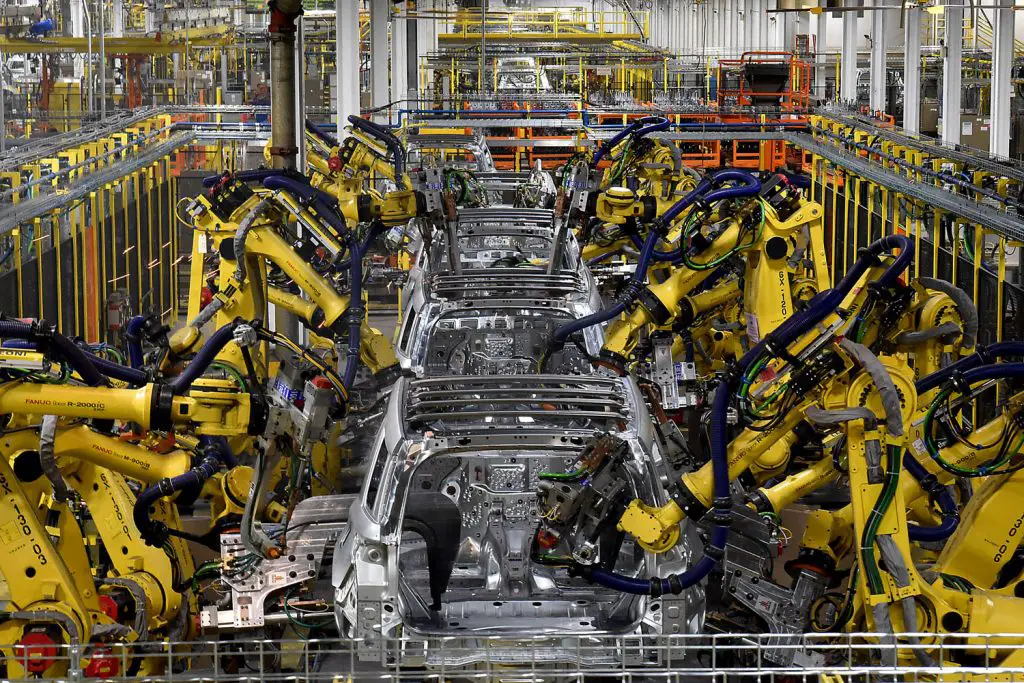
In factories, the robots don’t look like humans. In this fictional video, the robots building humanoid robots are not humanoid

(https://www.youtube.com/watch?v=aaWfVz25R0A, 3-minute view).
And robots building cars don’t look like humans. (Image Credit: https://fordauthority.com/wp-content/uploads/2019/06/ford-chicago-Assembly-Plant-006-1024×683.jpg)
Maybe we need robots to look like us so we can relate to them. Humanoid robots can operate in a human-sized world. They can ride in our cars, climb stairs, fit through doors and, depending on their design, respond to inquiries and instructions in familiar ways—they can coexist in our world.
On the other hand, that may spark objections to using them: they look and feel more like something taking our jobs, our human nature, our achievements. New technology always generates change, but somehow this feels different.
Science fiction films are replete with ways, good and bad, that humanoid robots interact with humans. Most people are familiar with The Terminator movies, which interestingly had two versions of the “killer robot”—one evil, one kind of good. But then there’s Robin Williams’s Bicentennial Man, where a humanoid robot grows ever more human. A kinder, gentler vision of a humanoid robot.
But there are the ones that are just disturbing, viscerally objectionable for some I would imagine. In Ex Machina, I found the treatment of the robots unsettling. I’ll bet most people were not okay with the Oscar Isaac character, even though his perversions were directed at machines. I wonder who sympathized with Ava and her action of escaping into the real world.
Probably little known is Maid Droid. A perfectly simple application of a humanoid robot: house-cleaning. But one owner is an abuser and the other a lover. It’s not the best movie, but I think it depicts a key understanding for me: how we treat humanoid robots, particularly as they get more sophisticated, might say more about us than about the robots.

And finally, I have to mention Cherry 2000, starring Melanie Griffith. (Available on a variety of streaming services.) In the beginning, the male lead is perfectly happy with his robot wife, until she short-circuits in a kitchen accident. To recapture what he lost, he heads out on a quest. Well, he meets Melanie and learns the real deal is better than the best robot. (Image Credit: https://amazingmovieposters.blogspot.com/2015/09/cherry-2000-1987.html)
In the end, robots are here and getting more “human capable” with every new version. Science fiction might provide some insight into avoiding the worst of the changes we’re most definitely going to experience.
Leave a comment and let me know what you think.
Thanks for stopping by.
Steve, I think you’re right that making humanoid robots has traditionally served the primary purpose of making them relatable to us, perhaps with a secondary purpose of feeding our imagination about what might happen, should they become indistinguishable from us, if they supercede us.
They could, however, serve a more important function. If AI is used to design anything that humans use (e.g., sports equipment, vehicles, kitchen utensils), a humanoid robot could be useful for testing. Is the item safe, easy to use, etc., for an actual human?
Doug – Thanks for the comment. A unique idea I’ve not seen before. Totally makes sense though. Kind of a high functioning “crash test dummy”. Thanks for reading and for commenting.