
When I first planned this installment of the Mars Beckons blog, I thought I’d be discussing what the astronauts/settlers would do on the way to Mars. Once it’s time to go, about every two years, we’ll see anywhere from four astronauts (the crew size of NASA’s Orion spacecraft) to one-hundred settlers (Elon Musk’s reported passenger compliment on Starship) heading out on a six-month journey to The Red Planet. That’s a long trip and a long time to be in transit.
So—what will they do?
There’s not much information out there. Science and Research. Health and Fitness. Leisure and Relaxation. That’s it. Those are all the details I can find.
To be sure, we’ve learned from the almost twenty-five years (twenty-five years on 11/02/2025) of occupying the International Space Station (ISS) that health and fitness are a must. Six-months of living on the ISS can cause muscle weakness, bone loss, immune deficiencies, etc. Exercise and constant health monitoring are essential. Consider the challenges of six to nine months of transit time to Mars, a year or more in partial gravity (Mars’s gravity is about 38% of Earth’s) and then a six to nine months return trip. The Health and Fitness requirements are compounded.
And of course, we all need time off to recharge, enjoy our personal interests, connect with friends and family, and so on. The first travelers to Mars will need the same. But how will that work with twenty-minute delays in communication, limited space (and mass) for non- critical materials and supplies? And you better enjoy the conversation of your fellow travelers.
These are all topics that could deserve their own blog post series. If you’re interested in a more detailed discussion of these topics, I’d suggest checking out the NASA site for the ISS at International Space Station – NASA.
But I can imagine, as any science fiction fan can, how they might feel in the confines of a steel box, traveling twenty-five thousand miles an hour, tens of millions of miles from Earth. My research led me to consider the “steel box” aspect of the trip.

For NASA’s Orion spaceship, the confines are just that—confining. The craft is approximately sixteen feet in diameter, ten feet tall, and tapered. That’s smaller than my living room, and I don’t live in a large house. Imagine spending six months in that space—with three other people. [Image Credit: Orion Interior – NASA] I would find that claustrophobic and anxiety-laden. At the very least, I’d need to get away from my fellow travelers and have some “alone time.” I’m pretty sure I would not be a suitable candidate for the trip. Would you?
Now that space won’t carry all their supplies, plus the room and equipment for the essential activities “detailed” previously. The information I can find is that Orion will dock with a larger habitat module, still under design. We’ll see what that module looks like when details become available. [Note: if anybody has found an early rendering, let me know in the comments.]

Then there’s Starship. A larger spacecraft, maybe accommodating maybe 20. One schematic shows areas for sleeping quarters, equipment storage, etc.
[Note: this is not a SpaceX rendering. Image Credit: All+Decks+of+SpaceX+100-passenger+Starship+design+by+Ace+%26+Michel+Lamontagne.jpg (1371×1673)]

Starship is still in development, and the component planned to travel to Mars is not finalized; that’s years away. But that’s not to say we can’t consider what might be on the ship. Unlike Orion, docked to a larger habitat module, which will not land on Mars, Starship is expected to do just that. We can expect then that Starship will have space and equipment for the journey to Mars, plus what the astronauts will need to land and operate on Mars.
One futurist has prepared a short (~13 minutes) video about what Starship might look like. [Video URL: https://youtu.be/XC3dwEVxYEM]. Although Elon Musk has mentioned one-hundred people per trip, the video suggests it will probably be closer to twenty. But the ship in the video looks spacious and accommodating.
Of course, movies have contemplated the interiors of Mars-bound spaceships for years. Their design aesthetic

is interesting to ponder. I’ve always loved the aesthetics of the 50s. Plenty of room to conduct experiments. Like today, 1959’s The Angry Red Planet contemplated doing scientific experiments.

Plus plenty of room and time to have interesting discussions, when you’re not pressing all the buttons, turning all the knobs, and pulling all the levers.
[Image Credits: https://www.bing.com/images/search?q=Angry+Red+Planet+Faint+Nora+Hayden&FORM=IRIBEP https://tse4.mm.bing.net/th/id/OIP.iK3ov0FKwI9kTGjCyjnZlgHaEL?r=0&rs=1&pid=ImgDetMain&o=7&rm=3]
As we move forward in time, the sets become more “futuristic” but are of a type that the Dragon craft sports.

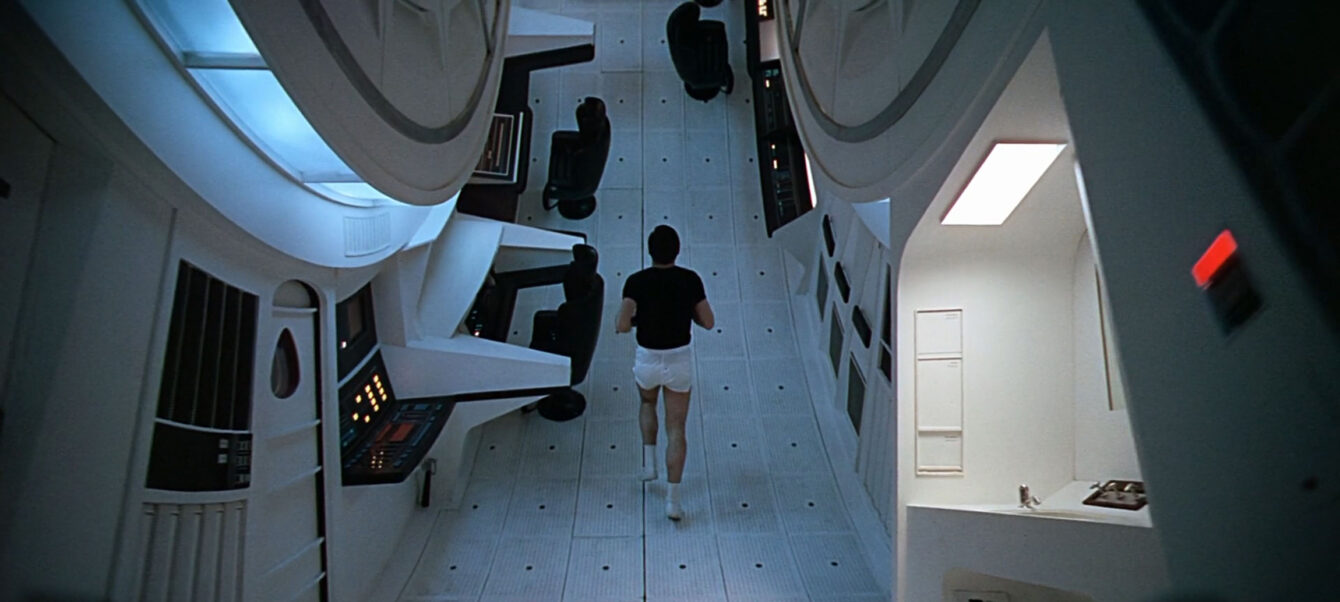
Sleek. Clean. No knobs and buttons. This aesthetic actually isn’t that new. Just nine years after The Angry Red Planet, we got 2001: A Space Odyssey.
[Image Credit: 2001-A-Space-Odyssey-57.00-Jupiter-Mission-Exercise-1340×602.jpg (1340×602)]

Which is of a type reflected in the movie The Martian, from the novel by Andy Weir of the same name. If anything, the latter interior is busier. [Image Credit: OIP.QiuX7Nv8LKWrsbuDrfBNGgHaD1 (474×245)]
In all these instances, there’s plenty of room to move around, exercise, spend leisure time, conduct work, and engage in other useful activities. It seems the filmmakers, as far back as at least the 50s, knew what NASA and SpaceX are addressing. On long missions, people need to pursue: Science and Research. Health and Fitness. Leisure and Relaxation.
Are you ready to sign up? Let me know what you think about spending six months in a steel box, traveling twenty-five thousand miles an hour, tens of millions of miles from Earth, with your soon-to-be closest friends.
Don’t forget the Scabble game.
Thanks for stopping by.